

A special side event will bring together research, innovation and policy perspectives to explore pathways towards more resilient agri-food systems across the Mediterranean.

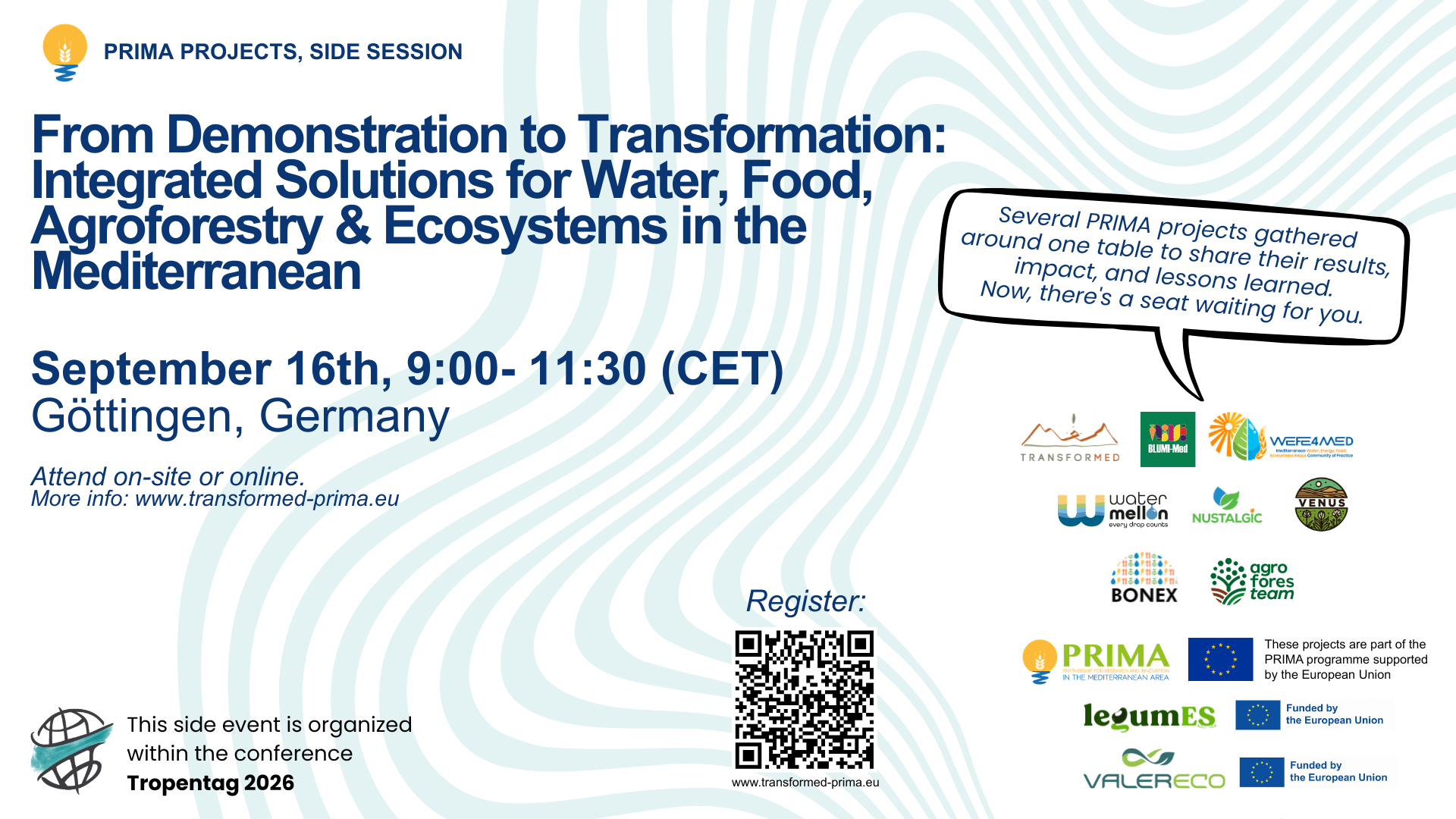
On 16 September 2026, ten PRIMA and EU-funded projects will come together at Tropentag 2026 for a special side event dedicated to sharing knowledge, exchanging experiences and discussing how research results can support sustainable development across the Mediterranean region.
The hybrid event, taking place in Göttingen, Germany, and online, will provide a unique platform for researchers, practitioners and policymakers to reflect on lessons learned from years of collaborative work and explore opportunities for scaling successful approaches beyond individual project boundaries.
The initiative brings together the projects WATERMELLON, NUSTALGIC, WEFE4MED, VENUS, TransforMed, BONEX, BLUMI-Med, Agroforesteam, LegumES and VALERECO, each contributing expertise from different areas of sustainable agriculture, water management, biodiversity conservation, agroforestry, circular value chains and ecosystem resilience.
Event Information
Date: 16 September 2026
Format: Hybrid (Göttingen, Germany + Online)
From Project Results to Regional Impact
Mediterranean countries face common challenges related to water scarcity, climate change, biodiversity loss and the sustainability of food systems. Over recent years, numerous research and innovation projects funded through PRIMA and European programmes have developed solutions, generated evidence and tested innovative approaches to address these issues.
This side event aims to move beyond project-specific outcomes and create a broader conversation on how accumulated knowledge can contribute to long-term regional transformation.
Participants will discuss what has worked in different contexts, which solutions can be scaled, and how research findings can better inform policy development and implementation across the Mediterranean basin.
Three Thematic Discussion Areas
The programme is structured around three interconnected thematic blocks:
Integrated Water Management & Agroecological Restoration
This session will examine innovative strategies for improving water use efficiency, restoring ecosystems and strengthening the resilience of agricultural landscapes under increasing climate pressures.
Biodiversity, Neglected Species & Circular Value Chains
Discussions will focus on the role of biodiversity in sustainable food systems, the potential of underutilised and neglected species, and opportunities to develop circular and resource-efficient value chains.
Governance, Scaling & Policy Integration
The final thematic block will explore mechanisms for translating research outcomes into practical actions, supporting multi-level governance and creating enabling policy environments for sustainable innovation.
Building a Mediterranean-Wide Conversation
While each participating project addresses specific challenges and geographical contexts, they share a common objective: contributing to resilient and sustainable agri-food systems across the Mediterranean region.
By bringing together experiences, methodologies and results from multiple initiatives, the event seeks to identify synergies, strengthen collaboration networks and enhance the overall impact of European and Mediterranean research efforts.
The organisers hope that this collective dialogue will support evidence-based decision-making and foster stronger connections between science, practice and policy.
The event was initiated by Harun Cicek from the Research Institute of Organic Agriculture (FiBL) and a partner of the TransforMed project, with the support of representatives from the participating projects and organisations.
Researchers, practitioners, policymakers and stakeholders working on water management, food systems, agroforestry, biodiversity and ecosystem resilience are encouraged to join this collaborative discussion and contribute to shaping a more sustainable future for the Mediterranean region.
