


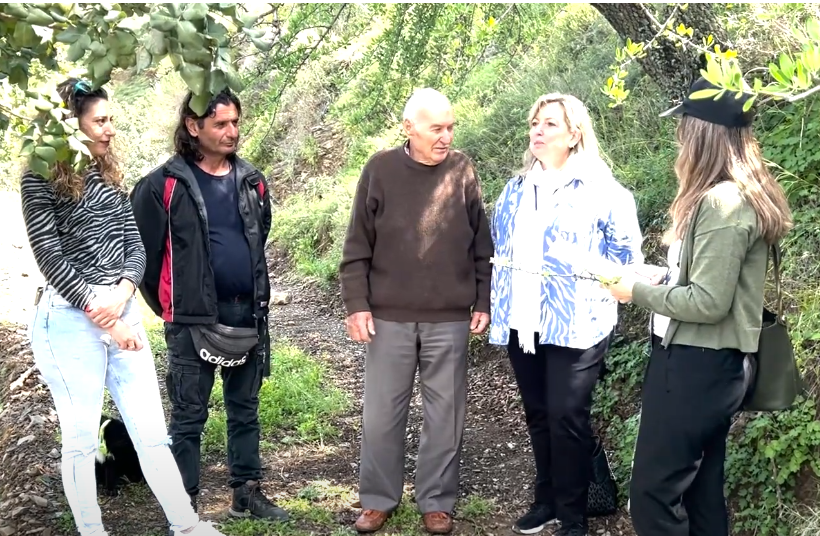
High on the steep terraces of Polyrrinia, in Kissamos, western Chania, the Sgouromalli family has been quietly tending an orchard that tells a story of resilience, tradition, and sustainable farming.
Spread across six hectares of rugged hillside (35.4439, 23.6634), the family’s land hosts around 2,000 carob trees (Ceratonia siliqua), planted in 2000 under a state reforestation program designed to revive marginal agricultural areas. Two decades later, the trees stand as a thriving example of what long-term dedication and low-input farming can achieve in Crete’s challenging landscapes.
A Partnership Rooted in the Land
Michalis and Amalia Sgouromalli have built their lives around both modern trades and traditional practices. Michalis, who works in earthmoving and tourism, often brings his machinery to the fields for seasonal agricultural work. Amalia, meanwhile, has taken the lead in managing the orchard, joining Greece’s “Young Farmers” program five years ago to strengthen their agricultural activities.
“It’s not just about production,” Amalia explains. “It’s about keeping the land alive and making sure it remains part of our family’s future.”
Sustainable Farming Practices
The orchard is as much a product of patience as it is of planning. For the first four years, the trees were supported by drip irrigation; since then, they rely entirely on rainfall. No fertilizers, pesticides, or herbicides are used — a testament to the carob tree’s natural hardiness and the family’s commitment to low-input cultivation.
Annual tasks follow the rhythm of the land:
-
Mechanical weed control, carried out by Michalis with a rotavator, takes about 50 hours each year.
-
Pruning and canopy management, involving two workers over 10 days, demand around 160 hours of labour.
-
Harvest season, the most intensive period, lasts roughly 25 days and engages four workers for nearly 800 hours.
The Carob Comeback
Once considered a humble staple, carob is now enjoying renewed interest as a nutritious, climate-resilient crop. For the Sgouromalli family, however, its value has never been in doubt. “Carob has always been here,” says Michalis. “It’s part of Crete’s identity — strong, enduring, and able to grow where little else can.”
As global conversations on sustainable farming continue, the terraces of Polyrrinia offer a grounded example of how tradition, adaptation, and family effort can cultivate not just crops, but continuity.